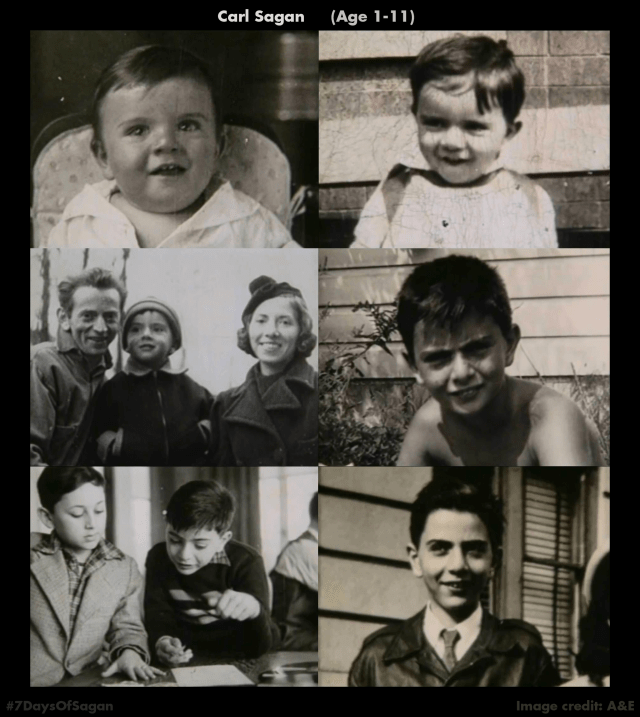
“I was a child in a time of hope. I grew up when the expectations for science were very high: in the thirties and forties. I went to college in the early fifties, got my Ph.D. in 1960. There was a sense of optimism about science and the future. I dreamt of being able to do science. I grew up in Brooklyn, New York, and I was a street kid. I came from a nice nuclear family, but I spent a lot of time in the streets, as kids did then. I knew every bush and hedge, streetlight and stoop and theater wall for playing Chinese handball. But there was one aspect of that environment that, for some reason, struck me as different, and that was the stars.
Even with an early bedtime in winter you could see the stars. What were they? They weren’t like hedges or even streetlights; they were different. So I asked my friends what they were. They said, “They’re lights in the sky, kid.” I could tell they were lights in the sky, but that wasn’t an explanation. I mean, what were they? Little electric bulbs on long black wires, so you couldn’t see what they were held up by? What were they?
Not only could nobody tell me, but nobody even had the sense that it was an interesting question. They looked at me funny. I asked my parents; I asked my parents’ friends; I asked other adults. None of them knew.
My mother said to me, “Look, we’ve just got you a library card. Take it, get on the streetcar, go to the New Utrecht branch of the New York Public Library, get out a book and find the answer.”
That seemed to me a fantastically clever idea. I made the journey. I asked the librarian for a book on stars. (I was very small; I can still remember looking up at her, and she was sitting down.) She was gone a few minutes, brought one back, and gave it to me. Eagerly I sat down and opened the pages. But it was about Jean Harlow and Clark Gable, I think, a terrible disappointment. And so I went back to her, explained (it wasn’t easy for me to do) that that wasn’t what I had in mind at all, that what I wanted was a book about real stars. She thought this was funny, which embarrassed me further. But anyway, she went and got another book, the right kind of book. I took it and opened it and slowly turned the pages, until I came to the answer.
It was in there. It was stunning. The answer was that the Sun was a star, except very far away. The stars were suns; if you were close to them, they would look just like our sun. I tried to imagine how far away from the Sun you’d have to be for it to be as dim as a star. Of course I didn’t know the inverse square law of light propagation; I hadn’t a ghost of a chance of figuring it out. But it was clear to me that you’d have to be very far away. Farther away, probably, than New Jersey. The dazzling idea of a universe vast beyond imagining swept over me. It has stayed with me ever since.
I sensed awe. And later on (it took me several years to find this), I realized that we were on a planet — a little, non-self-luminous world going around our star. And so all those other stars might have planets going around them. If planets, then life, intelligence, other Brooklyns — who knew? The diversity of those possible worlds struck me. They didn’t have to be exactly like ours, I was sure of it. ” — Carl Sagan, Wonder and Skepticism
 Elizabeth Karlsson